Don’t outsource your thinking, become an unsquiggler
Most leaders face problems that feel messy, ambiguous, and impossible to untangle. The temptation is to jump straight to solutions. But without a clear approach, we risk solving the wrong problem or creating more noise than clarity.
But how?? Where do I start the unsquiggling process?
I use a simple, three-step process that gets you to the heart of what matters and strips away confusion. This approach is based on structured problem solving.
The methods are grounded in the discipline of critical thinking and hypothesis-driven analysis and help to break down ambiguity into manageable steps — from defining the problem through to delivering clear and compelling solutions.
The popular book titled Bulletproof Problem Solving says structured problem solving “the one skill that changes everything”. It’s the foundational methodology that the world’s largest and most successful consulting firms use – and you can use it too.
The Three Phases
The traditional approach is 7 steps (popularised by McKinsey’s 7 steps model). But I think that’s too many, and while we might use all of them in complex problems, sometimes we lean more heavily on some of the sub-steps than others.
So I’ve chunked it up into three simple, steps - Discover, Test, Shape.
While the steps are presented in sequence, the process is iterative, not linear. This is a big strength in that it provides structure and allows for flexibility, which is essential when dealing with complexity. I like to think of it as three phases that you'll move back and forth between as new insights arise and potential solutions become clearer.
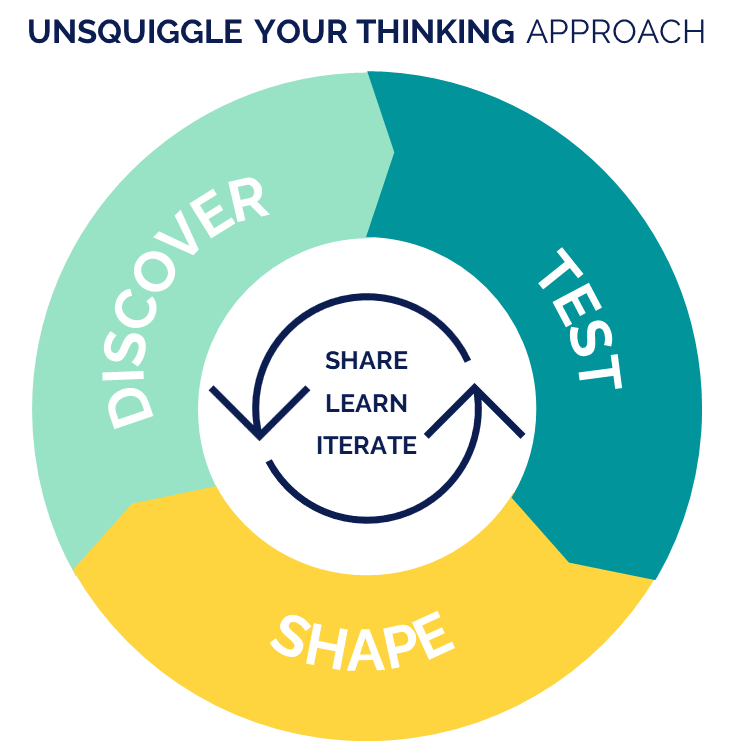
Here’s how it goes in each step…
Phase 1
Discover
This phase is about creating clarity about the problem by framing it, pulling it apart, and prioritising what matters most.
Frame – What problem are we trying to solve?
Get to the heart of the strategic question. Good framing prevents you from solving the wrong issue.
Outcome: a shared understanding of the problem, aligned with stakeholder needs.Disaggregate – What are the component parts?
Break the problem into smaller, logical chunks. This turns ambiguity into a manageable structure.
Outcome: a structured map of issues to explore.Prioritise – Which aspects matter most?
Focus on the issues that will unlock the biggest insights and impact.
Outcome: clear priorities and stakeholder alignment.
Phase 2
Test
This phase is about uncovering evidence. Here you uncover the evidence—planning and testing that will prove or disprove your ideas.
Plan – How will we test our ideas?
Design a workplan that connects questions, hypotheses, and data sources.
Outcome: a practical, hypothesis-driven analysis plan.Do – What does the analysis tell us?
Run the work, validate or disprove hypotheses, and adjust as insights emerge.
Outcome: evidence-based findings.
Phase 3
Shape the Story
This phase is about enabling decisions about solutions. Here you synthesise the findings into a clear narrative and communicate recommendations that drive action.
Synthesise – What story is the evidence telling us?
Bring the pieces together into a coherent “so what” that matters to your audience.
Outcome: a compelling, logically structured recommendation.Communicate – How do we drive decisions and action?
Present your message for impact. Structure matters: headlines, body, and “so what” kicker messages help your audience follow and act.
Outcome: materials that inform and influence.
Why This Works
This method balances structure with flexibility. It gives you a clear pathway while leaving room for the iteration and discovery that’s essential when dealing with spectacularly squiggly problems.
In my day-to-day strategy work, I am normally combining these structured problem solving methods with collaborative design – which is why share and iterate are explicitly called out in this version of the model as central and ongoing features. Using both methods (structured problem solving and co-design) always involves assessing the scale of the effort required for the problem at hand.
I find it helpful to think about the three lenses that Emma Blomkamp introduced recently on the topic of collaborative design: scale (how big), design (how wide), and collaboration (how deep).
Different problems have different shapes and scales that require different widths and depths of thinking and analysis. The beauty here is that you can apply this approach to long-term, multi-year strategy work—or to untangle a messy problem in an afternoon. The scale changes and the process adapts.
What’s Next
This article is the first in a series. Over the next three pieces, I’ll dive deeper into this outline and provide you with more colour, depth and examples across the three phases.
For now, keep this high-level guide handy the next time you’re faced with a messy challenge. It will help you discover the right questions, test what matters, and shape a story that leads to action.
Let’s unsquiggle this, good people!